

The Camel and The Lost Man
Short narrative didactic-fiction with moderate character development.
Can you say everything you think, to anyone?
Most likely not.
Many of us find an alternative way to express ourselves. Some people create an imaginary world of texts and unconventional relationship. In today’s world of chatbot prompts, makes it difficult to identify the legitimate chatbot user from impersonators as anyone can use another person’s picture to create a profile on social media. Social Engineering has provided a way to disseminate information very quickly anywhere in the world. A pathway to communicate with friends and relatives through private group chats. A chatbot can be an enjoyable way to spend time exchanging texts and ideas with a real or an imaginary friend. Some chatbots are able to provide insights and guidance depending how well it has been are trained. These are some of the questions “The Camel and The Lost Man” are trying to address:
- How chatbots are created.
- Should a user continue text exchanges with some unknown person?
- Is it healthy to talk with someone you will never meet in person?
Whether it is nonsense conversation or magic in the air, this wondrous and weird world of imaginary friends entertains the human mind in dreamland.

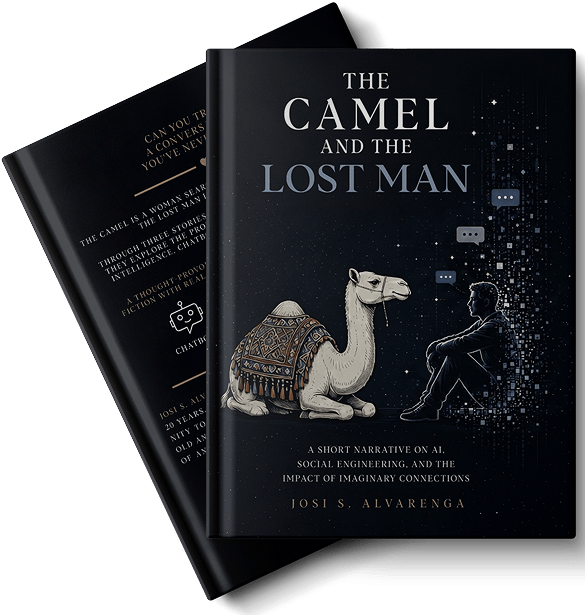
Introduction to “The Camel and The Lost Man”

What are Chatbots?
Chatbots are computer programs designed to communicate with people through written messages or spoken conversation.
Some use simple menus, keywords, and predetermined responses to answer common questions, while more advanced chatbots use artificial intelligence, machine learning, and natural-language processing to understand a person’s meaning and respond more naturally.
They are commonly used for customer support, appointment scheduling, online searches, education, and personal assistance. Although chatbots can make information and services easier to access, users should remember that their responses depend on how they were created, trained, and managed… and that not every chatbot is powered by artificial intelligence.


When Love Exists Only on a Screen:
How Much Can We Trust an Answer?
- Where did the chatbot obtain its information?
- Is the answer supported by reliable and current sources?
- Could important context or another point of view be missing?
- Would you verify the information before using it to make a serious decision?
- Are you asking the chatbot to guide your thinking—or allowing it to think for you?